Wednesday, 12 October 2011

My Days in the North: Derry

          My days up here in the North of Ireland have been very intense and very interesting. Since my last series of posts, I have spent time in Belfast, in the dorms of Queens University, at the Corrymeela Reconciliation and Spirituality Center, along the north coast of Ireland, and I am now living in the Bogside District of Derry/Londonderry, in the Catholic ghetto for the week. I have never lived or spent much time anywhere like where I am staying here, there is still an active contingent of the IRA present in these neighborhoods and fights and attacks between police, Loyalist paramilitaries, and IRA supporters break out fairly frequently. Just last week, three miles from here, a constable's house was blown up by Continuity IRA for his position in the security forces. Our program specifically scheduled our stays so that we would not be in Derry over a Saturday night, because that is when most of the violence tends to occur. The Orange Order still marches around the walls of Derry every Saturday afternoon, which incites rioting from the Nationalist Catholic youth, and typically, the fighting escalates into the night, with petrol bombs and Molotov cocktails being thrown at the Loyalist marchers and the police forces most weekends. Its incredible to be right in amongst it; Derry is said to be the front lines of the continuing troubles, and still is known as "The City Under Siege" by both sides.

         Historically, Derry is famous for being the Walled City of the Ulster Plantation. It is more sectarian than any other place in the North, because, unlike the other planters of Ulster, who were Scottish that moved in to settle the region, Derry settled by actual English Londoners- hence the name "Londonderry." The loyalists feel more allegiance to England than anywhere else in Northern Ireland, and historically held all the power over the city and the county despite the fact that they only make up about 10-15% of the population. To add to this animosity, when the vote for independence came in 1922, the County of Derry would have, by all rights, voted to break away and join the Republic of Ireland, but just before the vote, the Protestant Loyalists in power redrew voting districts and changed suffrage requirements to prevent the large majority of Irish Catholics from voting for independence, leaving the Irish Catholics of Derry feeling abandoned and oppressed. In the recent struggles, Derry has become infamous for the Battle of the Bogside and Bloody Sunday, where 13 protesters were gunned down by British paratroopers in the Bogside Catholic Ghetto.

The Walls of Derry- 
Historically, only Protestants were allowed to live within the walled city center of Derry. Catholics were subjugated to live outside the town walls in the boglands, since the walls were built to ward off Native Irish attacks.

Coat of Arms of Derry, on the Guild Hall
The Skeleton symbolized the 9,000 residents that starved to death during the 
Siege of Derry in the Williamite Wars

Loyalist Communities feel surrounded and under siege as well from the Catholic majority

The Protestant Cathedral of Derry

One of the Original 48lb. Mortar Balls fired over the Walls into the town during James II's siege of Derry

From the Walls, looking over the hostile residents of the Bogside

Entering the Bogside- The people of this district declared themselves independent of Great Britain during the Troubles, and for three years in the 1970s, police were unable to enforce jurisdiction in "Free Derry"

The River Foyle and the Waterside District

The Walls of Derry

Wednesday, 5 October 2011

Faughart- Gaelic for "The Good Art of Killing"

      The village and valley of Faughart lies on the border of Northern Ireland and the Republic, in County Louth and is very rich in historical significance. Saint Brigid, the traditional maternal saint of Ireland, was born in the valley in the fifth century A.D. and was a contemporary of Saint Patrick. Her holy well sits on the hill overlooking the valley and is said to cure ailments of the mouth, throat, eyes and ears.
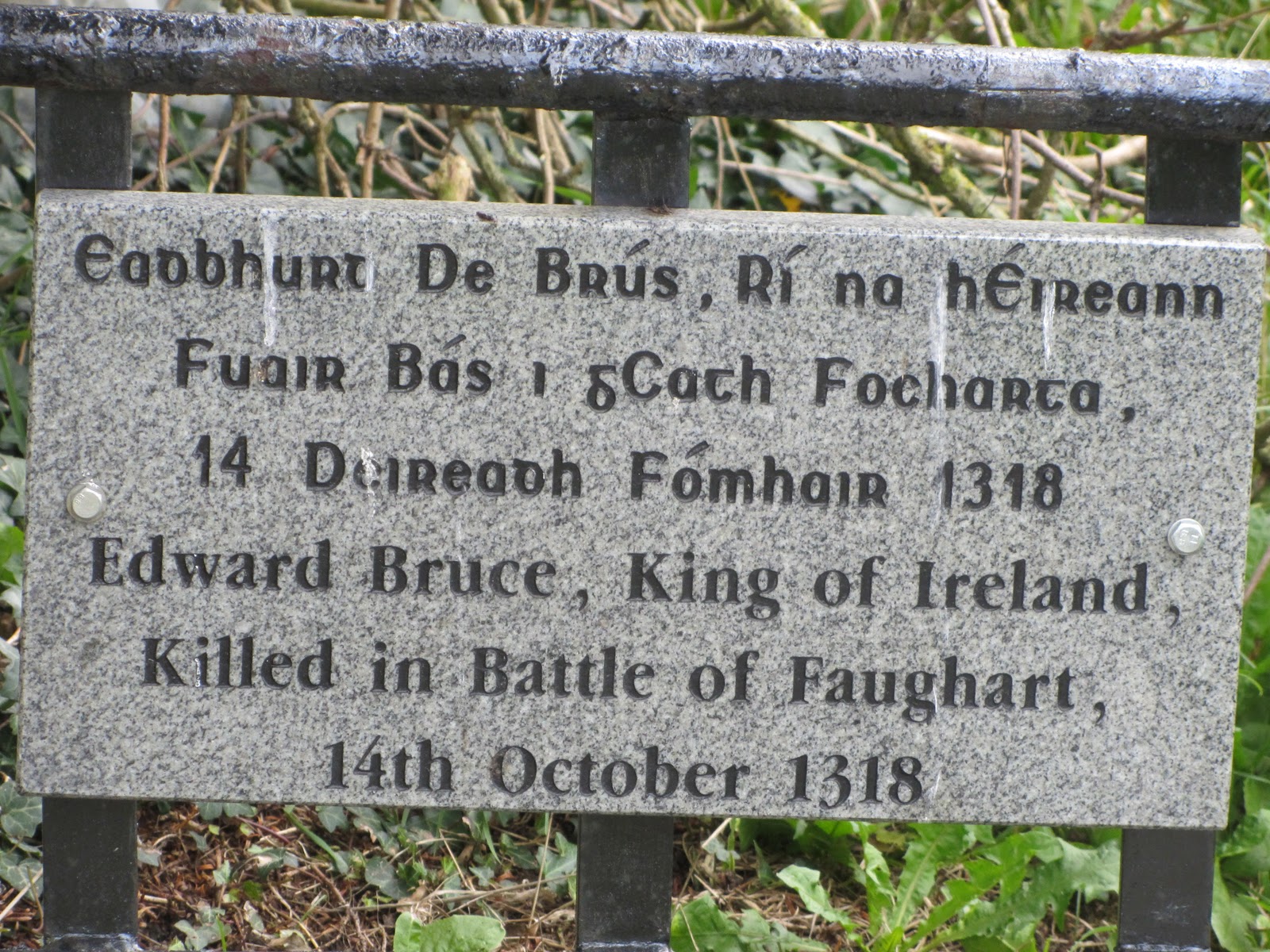
      In the 1300s, it is where Edward the Bruce came to make his claim for the Irish Kingship. Edward the Bruce was a Scotsman, and younger brother to Robert the Bruce, who is depicted in the movie Braveheart bidding for the Scottish throne. Robert eventually does become king of Scotland through a series of battles with the English in the early 1300s, and by 1315, the two brothers had conspired a plan to unite Ireland and Scotland in a great Gaelic empire against the forces of England. Robert the Bruce, King of Scotland, was to invade the Island of Man, and Edward was to Ireland to claim the Irish throne and then move on to reclaim Wales.. The O'Neills and a gathering of the other Irish earls declared loyalty to Edward at his arrival, making him, technically, the last High King of Ireland. Roger Mortimer and other Englishmen living in Ireland became alarmed at the arrival of Edward in Ulster, and sent for help from Edward the Second of England. In 1318, in the valley of Faughart, a huge  English/Irish army of 20,000 surrounded Edward and about 5,000 Scots and Ulster-men and slaughtered Edward the Bruce's forces, and it is from this battle that the town and valley got their name of Faughart. Edward himself was slain during the battle, and with him died the prospects of a united Gaelic kingdom. His body was cut into pieces by the English, and his head sent back to Dublin as proof of victory. After the English had left the battlefield, however, survivors and locals gathered up his different limbs and torso and interred them on the hill of Saint Brigid, marking the grave as that of "Edward the Bruce, High King of Ireland." His headless body still rests on that hill today.

The Valley of Faughart

Final Resting Place of Edward the Bruce's Body


Entrance to the Holy Well of Saint Brigid

Saint Brigid's Well

Tuesday, 4 October 2011

The Cathedrals of St Patrick in Armagh

Armagh City, in County Armagh, Northern Ireland, was traditionally the religious seat of power in Ireland, due to its connection with Saint Patrick, the patron saint of the island. On the hill of Armagh is where Patrick set up his first mission in Ireland, and is where, later, his cathedral was built. Now in the time of Henry VIII, when the churches in the English realm were transferred over to the Church of England, and the same holds true for St Patrick's Cathedral, which became part of the Anglican Church, and the center for the Anglican denomination in Ireland. The native catholic population of Ireland, as can be expected, did not appreciate losing their patron saint's cathedral, and so, when it became legal to do so, in the 1800s, they built their own Saint Patrick's Cathedral, on the adjacent hillside from the original, and now today, the two cathedrals face off, with the valley of Armagh City between them.

The Historical Cathedral of St Patrick, originally built in 445 A.D. and 
subsequently repaired, added to and restored over the centuries. 


The authentic battle flags of the Ulster Regiment of the British Army-
served at the Battle of Niagara in the Seven Years War, the Peninsular Campaign of the 
Napoleonic Wars (where they captured an imperial eagle), the Crimean War, the Zulu Wars, 
the Boar War and World War One

The last High King of Ireland, Brian Boru, had his body brought back to the Cathedral of Saint Patrick in Armagh to be buried under the eastern wall of the church after he was killed in battle, in 1014.


The Catholic Cathedral of Saint Patrick, on the hill facing its competitor

St Patrick with St Brigid and St Kevin

Saint Patrick

The Eleven Apostles that will be sitting at the right hand of Christ

Sunday, 2 October 2011

Homecoming!

This is exciting news for all the Nelsons, today, I went back to the little village in County Down where we trace our Irish ancestry. The town of Saintfield (Tonaghneave) has a population of about 2,000 people, and is situated just Southeast of Belfast, in Northern Ireland. Our direct ancestor, William Samuel McConnel and his wife Susannah came from this village in the year 1798, settling in Vermont and then eventually, Ohio. Today, I went back and actually found the church our ancestors went to, the graves of William Samuel's father, and the town where they lived.

As I got off the bus in Saintfield this morning, the church bells were ringing, calling the people to the service that was about to start. I rushed into the churchyard and up the stairs of a little stone church, the First Presbyterian Church of Saintfield, that our ancestors were members of. A man greeted me at the door and gave me a bulletin. He asked me if I was visiting, and when I said yes, he looked at me and asked where I was from. I told him America, and he said he could tell from the accent, and wanted to know "how on earth I had found myself in Saintfield, and at the Presbyterian church for a Sunday morning service." As I told him the story that I had traced my genealogy back to this congregation in the 1700s and come out to see the church for myself, his look of confusion turned to one of amazement and excitement. He welcomed me in and and immediately took me in to introduce me to the other members of the congregation, the deacons, the trustees, and the minister. As we went from person to person, he told my story, of how I had "come all the way from America to find my old home in Saintfield." The old women hugged me and told me "Welcome home" and the men shook my hand and asked what the name of my family was. I told them McConnel and the older and more involved ones shook their heads and said yes, that was one of the old names, from the families that founded the church in 1658. By the time I had made the rounds with this usher, named Kenneth Finlay, it was time for the service to start, so I took a seat and the minister announced from the pulpit that "this young man (me) has come all the way from the States to join us today, as one of our own. His family belonged to this congregation in its earliest roots, and let us welcome him today." It was an incredible feeling of homecoming, as everyone welcomed me and greeted me so friendly.

After the church service, my new found friend Kenneth introduced me to the church historian, who told me more information about my family. They have the marriage record of William Samuel's parents, dating from 1739, and a record of McConnels in the church from its founding in 1658. They also showed me the gravestone of William Samuel's father, behind the chapel in the old church plot. He was buried there in 1780. Then, they told me the most exciting part of our family history of the day:

        In October of 1791, in Ireland, a society known the United Irishmen movement was formed, with the goal of a Republic of Ireland, free from British rule, and achieved through a coalition of Catholics, Anglicans and Presbyterians. They based their ideas off of the American Declaration of Independence, and in essence, became the foundation for Modern Irish Republicanism and the sense of a United Irish State. They began planning for a revolution against the British under the leadership of Theobald Wolfe Tone. Excitingly enough, the First Presbyterian Church of Saintfield, where our ancestor William Samuel McConnel served in the leadership, was one of the strong supporting congregations of this movement in the northern counties. His minister, Reverend Birch, was a firebrand, who preached treasonous anti-British sermons from the pulpit.  Tensions between the British and Irish escalated over the course of the following years, as Revolutionary France began to support the goals of the United Irishmen, and finally, in 1798, the Irish revolted against British Rule, and our ancestor joined in the Rebellion, fighting on the side of the United Irishmen's Movement.
       The previous year, a local loyalist family had reported Reverend Birch and his congregation to the authorities for seditious activity, and when the warrant came for their arrest in June of 1798, the United Irishmen attacked the fortified blockhouse of the loyalists in order to oppose the arrests. William Samuel McConnel participated in this attack and the battle to come. As the Irish laid siege to the blockhouse, English reinforcements marched from Belfast to put down the rebels. As they marched into Saintfield, the rebels ambushed them just as they were crossing the stream behind the First Presbyterian Church. The battle that ensued became known as the Battle of Saintfield, June 9th 1798, and was an Irish victory over the British forces. Our ancestor went on the fight at the Battle of Ballynahinch, where the rebels were defeated three days later. In the aftermath of the battle, the British forces massacred many of the surrendering Irishmen, but luckily, our ancestor managed to survive the bloodletting and flee to Killarney with his wife, son, and other leading members of the First Presbyterian congregation. From Killarney, they sailed with their minister, Reverend Birch, to America, and accompanied their fellow fugitives to Vermont before finally coming to settle in Ohio by 1800.

Saintfield Town Center

Sanctuary of the First Presbyterian Church


The Bell Tower of the church was built in 1777, but the original sanctuary dates back to 1658, and is where, in 1739, our ancestor, William McConnel Sr. was married.


These guns, bayonets, swords and Pike-heads belonged to the United Irishmen of the First Presbyterian Brigade, who fought in the Battle of Saintfield on June 9th 1798. They are housed in the church's historical collection.

Site of the Ambush, in which William Samuel McConnel took part.


Graveyard where our ancestors are buried

The Irishmen lost between 30-40 in casualties while the British suffered 58 men dead and another 10 captured (later to be executed) during this engagement

Myself, in front of the First Presbyterian Church of Saintfield, just after our tea and scones

After the gentlemen of the church told me this incredible piece of my family history, and showed me both the cemetery and the battlefield where our ancestor would have fought for Ireland, I thanked them and said I had to catch my bus back to Belfast. They immediately protested though, and told me that I must stay for lunch to celebrate my homecoming. They took me to the meeting hall connected to the church, where we all (the congregation and I) had tea and scones first, for everyone to celebrate, and then my friend Kenneth Finlay took me back to his house for a Sunday Roast. With his family, I ate a lamb roast, potatoes, peas and carrots, along with lemon tart and custard for dessert, and they made me feel very at home. They even sang a song for me, called the "Star of the County Down," to welcome me back to the county of my family. It was incredible, and I didn't end up getting back to Belfast until 5:00 tonight, but it was worth it. We exchanged emails and phone numbers to stay in contact, and they even sent me some church mugs they had made for their 350th anniversary, to give to my grandma, whose branch it was that came over. It was, by far, the most exciting highlight of my trip so far.

Saturday, 1 October 2011

A Bombing Scare... Happy Birthday!

Today, an entire block of the downtown city center of Belfast was closed off due to a bomb scare, with roadblocks and Ulster Security Forces in the streets. The bomb was allegedly planted by some dissident IRA in a hotel downtown. Also, while we were touring the walled off neighborhoods of Belfast, in the Falls Road District (Catholic), and the Shankhill District (Protestant) a few fire-crackers and small explosives were lobbed over the "peace" wall  by young Protestant men. It was both exciting and disconcerting to think that this history and conflict we are studying is still going on right before our eyes. Also, while all this is going on, it is my birthday, so I will be celebrating my birthday tonight by going out to dinner with the other students in the group. Slainte! (Cheers in Gaelic)

Friday, 30 September 2011

The Irony of the Conflict in the North

There was a man named Nolan from Bally-binaby, a village square on the border between the Republic of Ireland and Northern Ireland, of the British Empire. One side of the town is in Free Ireland, and the other is in the Province of Occupied Ulster. Nolan lived in the Republic's side of the town, the local pub sat right on the line, and the village constable lived and worked on the British side of town, so he was part of the Ulster Constabulary Department. Now this man named Nolan was in the IRA in the 1970s during the early part of the Troubles, he was caught smuggling weapons into Northern Ireland, and held in jail as a political prisoner for six months in Belfast. He was eventually released, but under the restrictions that he would never cross the border into Northern Ireland again, under threat of further, more extensive incarceration if he was caught doing so. The local constable of Bally-binaby, was therefore assigned to assure he stayed on the Republic's side of the village, so for the next twenty years, every time the Sinn Feiner Nolan wanted to go to the pub, he had to call up his good friend, the constable, and let him know he was going down for a pint, and could the constable come down to monitor that he did not cross over to the side of the bar belonging to the British Empire. And so, every evening after dinner, the two good friends would meet down to the pub; Nolan sitting at the northernmost bar stool of the Irish Republic, and the constable sitting at the southernmost bar stool belonging to the British Empire, and they would drink their Guinness and Tennants together.

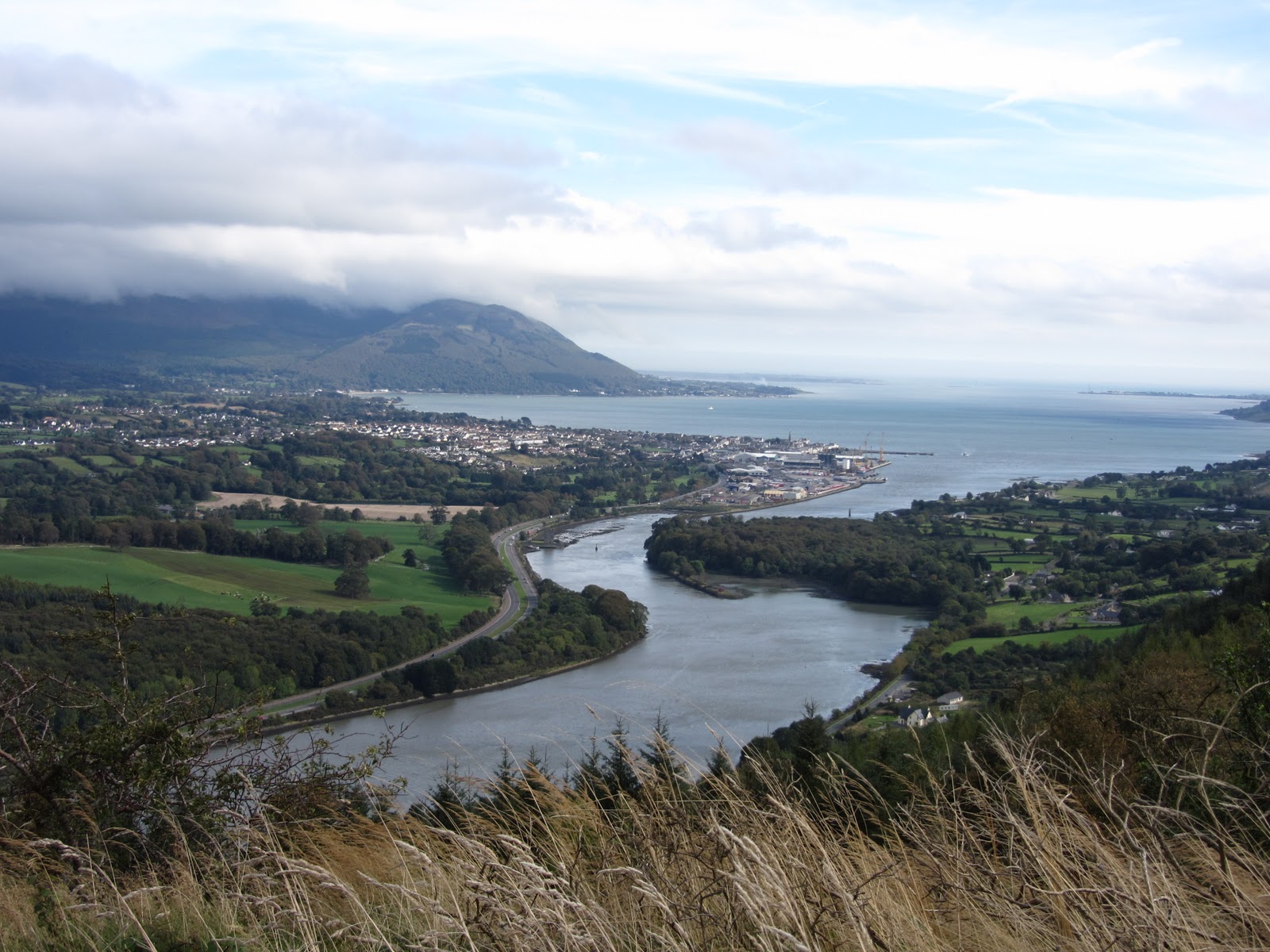
County Down- Warrenpoint


Along this road, running along the river separating Northern Ireland from the Republic, on the 27th of August, 1979, a British Army convoy was ambushed by a guerilla attack of the IRA, while headed into the town of Warrenpoint, down towards the coast. As the lorry loads of British soldiers drove past a point in the road, a bomb was detonated by the IRA, destroying the one truck and pinning down the convoy. After a half hour when the troops were subjected to sniper fire, a chopper arrived with reinforcements and as these reinforcements were setting up a command post at a nearby gatehouse, a second bomb was detonated where the IRA had accurately predicted the reinforcements would be landing, killing twelve more British. In all, 18 British  soldiers were killed in this attack, and the IRA column escaped unscathed. It goes down in the late history of The Troubles as being one of the most successful IRA ambushes, and while we were visiting this site, we were guided by Jim McAlistair, a reformed Sinn Feiner from South Armagh with IRA ties, who would have known the column of IRA volunteers who carried out this act.

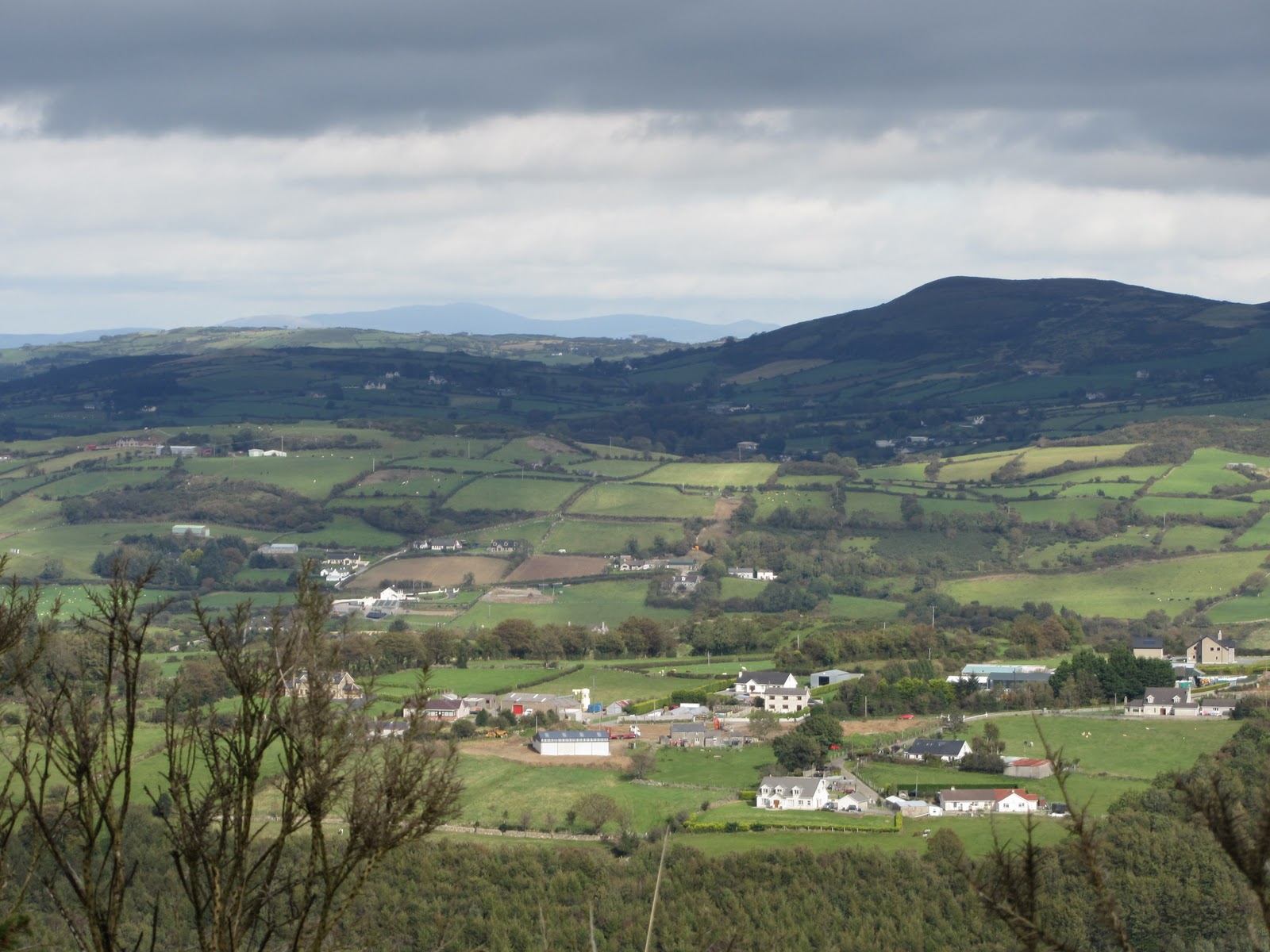
View of County Down from the Cooley Mountains
One of the branches of Nelson ancestry, the McConnells, originally came from Saintfield, in County Down, in the late 1700's.